
Wednesday, June 25, 2008

New Product and a New Look in the New GillBilly Store!


Take a moment and click on the title above and visit our GillBilly.com store front. We have introduced a new long bill cap with the GillBilly logo embroidered proudly on this quality Adams Sunblock Brand cap which a super comfortable fishing hat. It has a long bill for extra sun shade with a UV rating of 45. The famous GillBilly logo graces this hat telling everyone you know that "I FISH!".

GB Cap specs from the manufacturer... New Adam's Sunblock sun protection hat - Lightweight fabric (70% nylon, 30% cotton) with a ceramic coating designed to reflect damaging UV rays. Rated and labeled a full UPF 45+ sun protection. This is a top of the line sun protection hat with extra features and benefits: Treated with Teflon fabric protector to shield from stains. Washable, if needed, with instruction label sewn inside hat. Includes Adams exclusive COOL CROWN mesh lining to reduce heat.

Also, we have changed our graphics to give you a better depiction of our new and budding product line. Look for new designs that are hot off the presses to be introduced in the coming weeks.

As always, we strive to bring you the best in fishing wear, designed to grace your face with a smile and your bod with new great GillBilly Adventure Wear.


May the holes in your net be no larger than the fish in it.
Irish Blessing


Monday, June 23, 2008

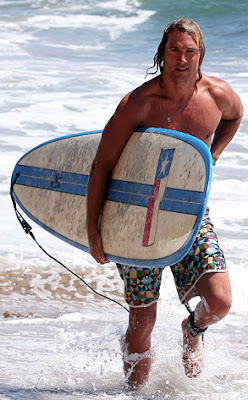
Surf Report: Malibu Surfers Assail Paparazzi to Protect Actor Matthew McConaughey


While paparazzo Josh Levine levies a $2.5 million lawsuit against Woody Harrelson for allegedly assaulting him and breaking his video camera two years ago, some other photogs might be heading to court over this past weekend’s beach battle with a group of surfers, who were either intent on protecting their hidden beach enclave from overcrowding, or view Matthew McConaughey as their leader who must be protected at all costs. The actor was at the center of what became a violent beach brawl after a mass of surfers came to his defense on Saturday and attacked a group of photographers following the actor.

The paparazzi were out in force over the weekend at Paradise Cove, on Malibu beach. Around a dozen were taking pictures as McConaughey surfed with his friends at the beach. Around 2 p.m. on Saturday though, things got pretty ugly. Surfers, who were reportedly drinking beer throughout the day, came up to the paparazzi in an aggressive manner and ordered them to leave the area. The surfers were made up of 15 young men. When the paparazzi refused, stating they were on public property and doing their jobs, the surfers reacted and began taunting them. The group of disgruntled surfers launched an all-out attack, allegedly leaving one paparazzo with a broken nose after being struck in the face. Another photographer was allegedly thrown into a mound of rocks by the group of angry surfers, leaving his camera equipment damaged. Police have confirmed a battery report has been filed by one photographer - though no arrests have been made, according to news reports.

And as paparazzi are wont to do, they were filming the entire time, which means video of the whole ordeal is available on (you guessed it) TMZ. The paps insisted they were just doing their jobs. Sites like TMZ, who showcase these videos, will insist they are just doing their jobs by reporting on the other paparazzi. And the elbow-throwing surfers will insist they were just doing their jobs, protecting McConaughey from a unscrupulous band of attack dogs who keep the actor’s celebrity alive and well. Matthew McConaughey did not participate in the ruckus. Matthew's representative has not made any comment on this incident.

They had requested on multiple occasions for the paps to stop taking pictures, which they would not stop doing. “There was apparently a fight, and a photographer gave a statement that he received injuries,” Los Angeles County sheriff’s spokesman said on Sunday. A surfer shouts at a photographer: “Get a real job.” The photographer says, “This is a real job. What do you do?” “I drink beer and party!” the surfer replied. The video shows a group of young men in swimsuits approaching and yelling at a group of paparazzi. One person of the group of apparent paparazzi appears to argue with the surfers. He says the beach is public property and they have the right to be there. The video shows two men chasing a paparazzi, dragging him into the water and kicking him. Click on this article’s title above to view the TMZ video.

Somebody just back of you while you are fishing is as bad as someone looking over your shoulder while you write a letter to your girl.
Ernest Hemingway

Sunday, June 22, 2008

Searcher Catch Report: Fish Jumping Everywhere!


Art Taylor reported this morning that fish are jumping everywhere and plenty of bait is in the water from 30 to 60 miles south of Point Loma! He also reported that his sportfisher the Searcher was up against the wall last night on the last day of a charter, bottom of the ninth inning with 2 outs, when his boat got hit BIGTIME! One half hour before dark on the longest day of the year, in a heavy fog, the charter anglers pulled in 32 bluefin and 12 albacore as dusk set in, somewhere carefully and cleverly unreported off the Baja coast. He said the water temperature was ideal and the only negative was 4 days of offshore fog, at times so thick the crew in the wheelhouse could not see the anchor on the bow! All this fog at sea as the Southern California area was scorching with heat. The bite was so good the fish even continued to swarm the boat after the darkness set in. Good signs for the fish soon arriving in southern California waters! Click this article’s title above to visit the Searcher Sportfishing Website.

There are two types of fisherman - those who fish for sport and those who fish for fish.

Friday, June 20, 2008

San Diego Catch Report: Albacore Getting Closer

If the albacore season is going to heat up, chances are we'll find out this weekend as more sport boats are set to cover a wider area offshore. Albacore bit as close as 63 miles and bluefin were reported at 40 miles this past weekend as the fishing season appears ready to go for sport fleet and private boaters. The Pacific Voyager, with Captain Mark Oronoz, checked in with 15 albacore from its two-day trip, with the fish landed Monday, the second day of the voyage. The fish mostly weighed between 15 and 18 pounds, with a 28-pounder topping the haul.

John Yamate of Seaforth Sportfishing said the Pacific Voyager was at 63 miles when it found the fish. Anglers caught some fish trolling and some on bait stops. “Mark said there were perfect conditions, with the water at 63.5 degrees,” Yamate said. The Legend, out of Seaforth Sportfishing, had one albacore last Sunday. The Apollo, out of Fisherman's Landing, also had a lone albacore early last week.

The Grande, on a two-day trip out of Point Loma Sportfishing, reported albacore Monday and yesterday. Sabrina Bartley of Point Loma Sportfishing said the Grande had one albacore yesterday after getting seven on Monday. The boat was 63 miles from San Diego. None of the sport boats reported bluefin, but private boat reports indicate bluefin as close as 40 miles and even albacore at 51 miles. Mike Gauger at Seaforth heard from a private boater who landed longfins at the 390 Bank, approximately 51 miles from Mission Bay.

All of the landings have boats ready to go if the fishing turns on. “It's hard to schedule trips because we just end up canceling them until someone really puts up a score,” Yamate said. This past weeks signs were promising, with albacore biting Tuesday as close as 30 miles southwest of Mission Bay for the El Gato Dos on a three-quarter-day trip. Turns out Captain Bryan Zulka's El Gato Dos was the last three-quarter-day boat to get albacore in September when his anglers boated three, and it's the first three-quarter-day boat to get into albacore this year.

Zulka was fishing southwest of South Coronado Island when the 24-pound albacore hit a black and purple jethead trolled by angler Eric Romberg of San Diego. Zulka said they were in 64.1-degree water along a break that went from 64.1 degrees to 64.6 degrees. His anglers also boated a yellowtail off a kelp paddy, some bonito and 25 rockfish. The El Gato Dos anglers also attracted a swordfish that refused to take the bait. Zulka estimated its weight at 150 pounds. They were approximately 26 miles south when the swordfish was spotted. Zulka said private boaters are reporting a mix of albacore and bluefin in the same zone he fished.

The Sea Adventure 80, in that area Wednesday, landed 13 albacore during a late afternoon bite of a 1½-day trip. Sportfishing operations based at both San Diego Bay and Mission Bay plan to cover a large area starting tonight. Most boats have spots open.

Thursday, June 19, 2008

CSI GillBillyville: Full Moon Tides are Washing Up Feet

Yet another human foot has washed up on the British Columbia Canadian coast. A sixth severed human foot has been found washed up on a stretch of coastline – sparking fears that a serial killer is on the loose. The grisly unidentified remains that have baffled cops all turned up since last August – two of them this week. The latest, a man’s right foot in a size 10 black Adidas training shoe, was on a beach at Spit River on Vancouver Island, Canada. Five right feet and one left foot have been found within an area of 150 miles in the Strait of Georgia, British Columbia. The first foot was found on Jedediah Island – by a girl who undid the laces on the size 12 white trainer to look inside.

This intensifying macabre mystery has flummoxed police and forensic investigators. Unlike the others that have been found, including one discovered Monday near Vancouver, this one was not detached at the ankle joint; there was no evidence of disarticulation. "It was cut clean, about three or four inches above the ankle bone. It was definitely severed, like it had been sawn off," said Sandra Malone, manager of Thunderbird RV Park and Campground in Campbell River, about 260 kilometres north of Victoria.

Ms. Malone was working what she thought was a routine shift at the RV park on Wednesday morning when a local woman approached her, obviously distraught. "She said she'd been collecting rocks for a craft project when she saw a shoe lying on the beach, just above the high-tide mark," recalled Ms. Malone. "She wasn't sure, but she thought there was a foot inside it." Ms. Malone followed her down to the beach. The shoe-clad foot was lying in plain view. "I could see two white bones sticking out of a black sneaker. The bones didn't have any flesh on them but they didn't look that old. The shoe was in pretty good condition but there was a lot of seaweed around it" said Ms. Malone.

The forth one was found on May 22 on Kirkland Island in the Fraser River. That complaint came in at noon from a passer-by who spotted the foot on Kirkland Island "with its shoe intact," according to Canadian authorities. The Coroners Service of British Columbia confirmed the remains to be human. The grisly finding may or may not be connected to other sneakered feet that have washed up in the province, said Cpl. Nycki Basra, spokeswoman with the Richmond unit of the Royal Canadian Mounted Police. "Right now, it's much too early to speculate," she said. "However, we are looking at a possible connection", she added. In February, a sneaker with the remains of a right foot was found on the east side of Valdez Island. Two feet were recovered last August in the same area, Gabriola, B.C. police said, adding that they have "yet to determine if foul play is involved." Police there say they've been in the process of reviewing all missing persons files that might be related to the discovery.

Police say DNA testing is being done on the latest foot, and DNA profiles have been conducted on the others. Curtis Ebbesmeyer, an oceanographer based in Seattle, Wash., said when a human body submerged in the ocean, the main parts like arms, legs, hands, feet and the head are usually what come off the body. "It's not unusual for body parts to wash up along the United States or Canada," he said. "There's so many accidents, like boating. That's not unusual."

Annie Linteau, a spokeswoman for the Royal Canadian Mounted Police, said: “We are exploring the possibility that it could be people who have drowned. It could be missing fishermen. It could be the remains of people who died in a plane crash." The bodies of four out of five men on a plane that crashed three years ago have still to be recovered. The only left foot found so far was recovered on Monday on Westham Island. Campsite manager Sandra Malone, who found the latest foot on Wednesday, said: "The leg bones were coming out of the running shoe. The foot appeared to have been deliberately severed." Police tried to calm fears that it is the work of a maniac, insisting there was no evidence the feet were deliberately cut off.

Police carry a foot, found Wednesday, near Campbell River, B.C. in a plastic container.

An angler is a man who spends rainy days sitting around on the muddy banks of rivers doing nothing because his wife won't let him do it at home.

Wednesday, June 18, 2008

GillBilly Chronicles: Fuel Rationing in Ensenada!


PEMEX is the world's fifth-largest oil company and Mexico's state oil monopoly, engaged in both upstream and downstream activities. The company accounts for approximately 30% of the Mexican government's revenues. Its vast oil and gas reserves include proven reserves of 34 billion barrels of oil equivalent. It is protected from competition in Mexico, where it enjoys a legal monopoly on the exploration, processing and sale of petroleum. And its privileged status in national mythology affords it a certain immunity from criticism. PEMEX is also in deep trouble. It's heavily-indebted and unable to provide the capital necessary to locate and exploit Mexico's oil deposits. In 2004, then Energy Minister Felipe Calderon announced that, without more investment, Mexico's known reserves could be depleted within 13 years. This wasn't the future envisioned by President Lazaro Cardenas, who expelled the foreign oil companies and founded PEMEX in 1938, to give Mexico's oil to "the people". Annual production has dropped each year since 2004. Furthermore, it has been reported the 2005-2006 daily oil production was down by approximately 500,000 barrels a day (a large proportion of the country's 4.5 million barrels) on the previous year.

The grades of PEMEX gasoline are "Magna" (Regular Unleaded 87 octane - green pump handle) and "Premium" (92 octane - red pump handle). Previously, PEMEX offered a leaded gasoline called "Nova," but this has been discontinued for environmental reasons (Nova gasoline, like many other leaded gasolines, have been discontinued due to stringent health regulations). Diesel fuel is readily available due to the large number of trucks on the highway - however, don't confuse the green Magna gasoline pump with a diesel pump as might be the case in the U.S.. The diesel pumps are often purple or red, and are usually sited on a separate island - the marking is "Diesel" or "Diesel Sin."

In the June 13th blog on this site an article described the huge run on fuel here at the Coral Marina in Ensenada, Baja California, Mexico by luxury yachts and north of the border sportfishing craft. This has concerned Baja residents as there is a fear that this will force the price of fuel up locally, to the near $5 per gallon for diesel north of the border. Diesel fuel here is near $2 a gallon and many locals wondered how this glut of traffic trending south to fuel would affect the cost and supply of fuel here in Mexico.

Now we know the results of this recent run on fuel, the PEMEX oil company is going to ration fuel to the Coral Marina PEMEX fuel dock as of yesterday. The fuel dock had been pumping an entire PEMEX tanker truck per day, some 5000 gallons per day! As of now, the fuel supply will be rationed and quoting Fito Espinoza, the dock master here at the Coral Marina, “the fuel will be conserved for those in the marina’s use as top priority.” Already the activity at the fuel dock has lessened and the affects of this fuel rationing program are already being felt. This news will quickly filter through the yachting and commercial fishing community and soon the stream of yachts will abate visiting the Coral Marina only for fuel and not for the pleasure of enjoying the Coral Hotel and Marina’s many amenities.

Below: the luxury yacht Shana visited the Coral Marina PEMEX fuel dock for an all day process of taking on a huge quantity of diesel fuel. This entailed a wait for another tanker truck to deliver more fuel to complete the transaction. Yachts like this will now find it more difficult to find the fuel they desire at low local prices.

"Rivers and the inhabitants of the watery elements are made for wise men to contemplate and for fools to pass by without consideration."
Izaac Walton

Tuesday, June 17, 2008

GillBilly Style Creole Fish and Chips


2 pounds Idaho potatoes, peeled and cut into 1/2-inch thick slices
1 3/4 cups all-purpose flour
1 cup ale or beer
1 large egg, lightly beaten
2 tablespoons milk
2 tablespoons GillBilly Catch of the Day Creole Seasoning, plus 2 teaspoons, plus more for dusting
1/2 teaspoon baking powder
1/4 teaspoon salt
2 pounds cod or pollack fillets, cut into 4-ounce pieces
6 cups vegetable oil
Malt vinegar, accompaniment

Heat the oil in a deep fat fryer or large, heavy pot to 350 degrees F. Preheat the oven to 225 degrees F.

Fry the potatoes in the oil until golden brown, turning to cook evenly, 4 to 5 minutes. Remove and drain on paper towels. Season with GillBilly Catch of the Day Creole Seasoning, to taste, and transfer to a baking sheet. Place in the oven to keep warm until ready to serve. In a bowl, combine 1 cup of the flour, the ale, egg, milk, 1 tablespoon GillBilly Catch of the Day Creole Seasoning, baking powder, and 1/4 teaspoon salt. Whisk to make a smooth batter the consistency of cream, adding more ale, as needed, to thin. (Use the batter as soon as possible after making.) Place the remaining 3/4 cup flour and 2 teaspoons GillBilly Catch of the Day Creole Seasoning in a shallow dish.

Season the fish with the remaining tablespoon of GillBilly Catch of the Day Creole Seasoning. Dip the fillets first into flour to lightly coat, then into the batter, and back into the flour, shaking to remove any excess. Fry in the oil for until crisp and golden brown, turning, 4 to 5 minutes. Remove and drain on paper towels. Season lightly with salt. Serve immediately with the fried potatoes and malt vinegar.

GillBilly Catch of the Day Creole Seasoning

2 1/2 tablespoons paprika
2 tablespoons salt
2 tablespoons garlic powder
1 tablespoon black pepper
1 tablespoon onion powder
1 tablespoon cayenne pepper
1 tablespoon dried leaf oregano
1 tablespoon dried thyme

Combine all ingredients thoroughly and store in an airtight jar or container.

"If people concentrated on the really important things in life, there'd be a shortage of fishing poles."
Doug Larson

GillBilly Chronicles: Pablito Saves the Fish

video

Monday, June 16, 2008

What is a RSW System Aboard a Fishing Boat?


Today's fishing industry grows more competitive with every catch. Distances become greater. Quality demands increase. To not only survive, but to maximize profits, it is essential to utilize the best technology and finest equipment available. Whether it is a small boat or a large fishing vessel, refrigeration is essential for delivering top-quality products and receiving premium prices from today's demanding seafood buyers. RSW, or refrigerated sea water is a relatively new technology to the commercial fishing fleet. There are 3 major factors that make this system an asset aboard the common day sportfisher or seiner.

THE VALUE OF INDEPENDENCE: With either spray or flooded RSW systems, vessel owners can achieve maximum flexibility in marketing seafood. Further RSW systems give freedom from the availability and supply of ice and also give the freedom of traveling much further to reach the optimum price buyer.

QUALITY DIFFERENCE: Seafood quality is directly related to the speed with which the product is chilled after harvest. RSW systems not only chill the catch quickly and uniformly, but maintain that ideal temperature environment over the length of a voyage. The result is more value, and more freedom in landing that catch in the best ports.

LESS WORK LESS WEIGHT: A further advantage of the RSW system is on board. Because the RSW eliminates the slow and fatiguing work of shoveling ice and layering fish, the boat crew is more efficient. On smaller vessels with spray systems the bulk and weight of ice is eliminated conserving fuel and increasing speeds.

The purpose of the refrigeration system is to remove heat from the seafood products as fast as possible into the evaporator and discharge the heat overboard through the condenser. Sea water can be cooled on board the catching vessel in two ways, by the addition of ice or by means of mechanical refrigeration, and shipboard tanks can be either built into the hull or portable for easy transfer to and from road transport at the quayside. The factors that influence successful RSW implementation are listed below.

TUNA PHYSIOLOGY: Tunas are well known for their higher proportion of lateral dark muscle, which is physiologically designed for continuous movement. Tunas are also unique in that their vascular system is designed as a counter-current heat exchanger (rete mirabile), to maintain the temperature within the muscle at about 3°C above ambient temperature in the case of yellowfin tuna, or up to 7°C in the case of skipjack; this maintains muscle efficiency, increasing speed and endurance. Red muscle in tunas is located internally, to further conserve heat. Muscle glycogen provides an energy store. Post-mortem glycolysis uses this store after the fish is caught to provide contraction of the muscle, exhibited as rigor mortis. This is also associated with heat production. Given the depth of the red muscle, its elevated temperature to start with and the loss of blood circulation as a cooling medium, the internal temperature can rise to the extent of causing a partial denaturing of the muscle protein. In tuna, more than most fish, there is therefore a need for rapid chilling after the catch is brought onboard. The use of refrigerated sea water (RSW) and brine freezing provides the rapid heat transfer needed to cool the fish quickly.

BRINE FREEZING PRACTICES: Brine freezing is used for large fish to be frozen whole such as salmon and tuna. The technique is used extensively on board tuna fishing vessels. The fishing vessel is fitted with one or more insulated tanks containing refrigeration coils. Brine freezing practices vary depending on the type of vessel, size of tank and catch rate. The following describes a typical practice.Before fishing starts, brine tanks are filled with seawater, which is then cooled to around -1°C. As fish are caught, they are dropped or flumed into the tanks, where they are chilled and held at this reduced temperature. When a tank is full, the RSW is pumped out and refrigerated brine is pumped in, and the temperature is lowered so that the fish freeze. Alternatively, if the catch rate is high enough, the fish may be put directly into refrigerated brine.The final temperature that can be achieved depends on the concentration of the brine - the minimum, when the brine is saturated, is about -21°C. Figure 1 shows the effect of brine strength on freezing temperature of the brine. In practice, brine temperatures can be anywhere in the range - 9.5 to -17°C, depending on the fishing vessel practice. Bear in mind that the engineer will not operate the brine at its freezing point (otherwise an ice slush forms which cannot easily be pumped) but will need a margin of a few degrees. Therefore to freeze at say -12°C, will need a 18 or 19% brine (with a freezing point at -15°C). As a result brine freezing of fish results in the final temperature at the end of freezing being much higher than the ideal.

During this past decade, the refrigeration technology industry has worked closely with fishermen and boatbuilders to develop the most reliable freezing and refrigeration systems for the world's small and medium-sized vessels providing RSW systems that are custom designed and built according to customer’s requirements.

"Scholars have long known that fishing eventually turns men into philosophers. Unfortunately, it is almost impossible to buy decent tackle on a philosopher's salary."
Patrick F. McManus

Sunday, June 15, 2008

GillBillyville Report - Baja Mamas Sunday Brunch


Do you like fresh oysters, clams and crabmeat? Do you also have an affinity for excellent Mexican pastries with a made to order omelet? How about adding a healthy selection of fresh fruits and vegetables and dips to compliment your meal? Do you enjoy the company of other likeminded folks celebrating the beauty of the morning and the Ensenada, Baja California area? All the while savoring perhaps the best biscuits and gravy you have ever experienced keeps calling you back for another serving. Would you like to have an all you can eat Sunday brunch for 10$ that includes all of the above plus a magnificent view of the Todos Santos Bay, Islands, and the Punta Banda ridge? Well my friends out there in GillBillyville, Baja Mamas Restaurant is definitely the place for you.

More a gathering at a treasured friend’s house than a restaurant, this place will charm you with not only the generous board of fare, but perhaps more importantly the new people you will meet and blessings you will delight in sharing together. After all, isn’t that what Sunday is all about, a day of rest and exaltation in the good lives we all are able to share? And yes, you will need to rest after this generous feed. You can grab a book in the library facing the beach, walk the beach, or just relax in the company of your new acquaintances. Dogs are welcome here and they too will look forward to Sunday as you will after visiting Linda, Ralph, Mike and their friendly cast of helpers.

Baja Mamas is located just off the road to the Blo-Hole or La Bufadora about 20 miles south from Ensenada on the sand spit that extends out into the Todos Santos Bay. Make the right turn at the last stop light and the “Y” split in the road as you pass out of Maneadero en route to the wine country of Santo Tomas and on to La Paz and the south cape of the Baja peninsula. After you turn right, be aware of the series of 7 speed bumps along this road, as they are very dangerous if you go over them at high speed. 7.3 miles after you exit highway 1 you will see a white sign on the right hand side of the road marked “Aguacaliente”. Make a right turn on this road, most of which is paved but there is a short ½ mile dirt section that navigates you to the paved road. About a mile after the occupied guard shack (just wave as this guy as he is just there to keep out the bad guys which you obviously are not) you will see one of the yellow Baja Mama signs guiding you to turn left toward the beach. Here you will encounter another guard gated stop at the end of the road. After a short uphill dirt road along a high wall you turn left to the restaurant a short distance down the road on your right and on the beach.

Today we took a fishing buddy that has definitely been around the block a few times and is a hardened Baja vet. Knowing the area, the available oyster, clam and crab population, we were interested as to his response to the feed. 3 buckets of clamshells later he was still smiling broadly and struggling with the urge to go back for more! These tasty treats are brought up from 100 miles south farmed from San Quintin where the water is much cleaner and the harvest much more pure of the pollutants up north. Oh, and yes for 10 bucks this is an all you can eat brunch establishment; we figured our buddy ate more than his share at that price plus had a serving of his own custom omelet and all the refreshment he could drink. I told Baha Mama he’d have to find his own way out there next time! No worries as she gets a kick out of making sure all are fed righteously and all the food is consumed by the end of the weekly Sunday brunch.

Linda, aka Baja Mama is you hostess, Fred, her husband and greeter, and Mike, their son and cook will all basically “Make Your Day”. This custom of serving started when they lived in Michigan. Weekly informal gatherings of families at their house grew to a scope that they were forced to develop the talent they now share for making all feel at home and comfortably well fed.

"Three-fourths of the Earth's surface is water, and one-fourth is land. It is quite clear that the good Lord intended us to spend triple the amount of time fishing as taking care of the lawn."
Chuck Clark

Saturday, June 14, 2008

Baja Report - New Yacht in Ensenada - On Our Bucket List


Recent new arrival in at the Coral Marina


"It has always been my private conviction that any man who pits his intelligence against a fish and loses has it coming."
John Steinbeck

Friday, June 13, 2008

Baja Report - Sportfishing Fuel Crisis! - Ensenada is a Welcome Alternative

Many charter sportfishing boats in southern California are mailing fuel surcharge charts to all of their new and annually returning customers. The fuel surcharge is designed to cover additional fuel costs and fuel costs only. The owners and operators of these craft have always tried to keep the price of fishing affordable and yet still pay the bills. The majority of local southwest charter boats have been lax over the past years in enforcing a surcharge, but now it is a necessity. As recently as February the cost of a gallon of marine diesel fuel was between $2.85 and $3.00, but now the cost is near or over $5!


The 112 foot long Independence based in San Diego burns on average 600 gallons per day during a typical fishing charter trip. She set her trip prices for the 2008 season when the cost of fuel was about $2.80 a gallon. Based on the above gallons per day fuel ratio consumption, the Indy charges a $5.00 per day surcharge for every .25 cents over the initial $2.80 cost on the 2008 charter price schedule. That works out to a $40.00 surcharge a day for every $2.00 of fuel price increase in cost. These projected season trip prices were set 9 months ago when fuel was at a relatively constant $2.80 a gallon, my how things have changed since then!


A welcome port of call on the horizon has altered the daily looming and spiraling disastrous fuel vortex enveloping the fleet. As of yet Mexico has not seen the cost of fuel rise significantly both on the road at the land based Pemex stations or on the sea at the Pemex marine fuel distributors. There is one fuel dock in northwest Baja located at the Coral Marina and Hotel near Ensenada. Here can be found a deal that the fish charter operators simply can’t resist! Priced at near $2.00 a gallon, the short trip south to visit the Coral Marina fuel dock pays for the trip and the necessary paperwork for customs turn around before heading back north to welcome the new boarding passengers in California.


Recently the Vagabond, Shogun, Islander and Top Gun 80 have visited the Coral Marina fuel dock. This is a very new experience for most if not all of the sportfishing boats based in southern California. These fishing expeditions can last up to 2 weeks or more. The Independence advertises a limited load of 25 passenger trip for $4250 each customer. This is a 16 day trip that will take the lucky passengers and crew to the tip of Baja California to catch huge and exotic sea fishing treasures. Bluefin, yellowfin, wahoo, and dorado as well as marlin will be gracing the decks of the Indy during that trip. At 600 gallons a day fuel consumption, the cost of fuel is a very important aspect of smart and financially successful trip planning. By the way, the record for whopper fish caught on the Indy is a 357.8 pound yellowfin tuna caught by Bill Asbell, undoubtedly on one of these long-range trips to the south of the Baja California peninsula.


Local Ensenada Captain David Camacho employed aboard the gringo luxury yacht Michelle Christina commented “I hope the fuel prices remain the same here in Ensenada, I have many friends in the Port of Ensenada that operate charter boats and they would not be able to support their families without the cost of fuel remaining low thus enabling them to continue their fish based trade.” Captain Camacho just returned the Michelle Christina from Puerto Vallarta where the owner and his family spent the winter fishing that mainland area of Mexico, a practice that many other yachts duplicate. Because of insurance reasons, those boats return north to Ensenada every year to summer in Ensenada and avoid the hurricane season that begins June 1st. These yachts are an important contributing financial force to the Mexican economy and the Ensenada area. Keeping the cost of fuel low locally will keep these yachts and the Southern California sportfishing fleet coming here and fishing Mexican waters.


Below: The Sportfisher Islander recently fueling at the Coral Marina fuel dock


Wednesday, June 11, 2008

GillBilly Chronicles: The Cigar Crazed Polluter Clan

One of the current most fashionable of fads, next only to the ownership of an SUV and cell phone - choking, er, smoking a cigar. Reminds GillBilly of all the yea-hoos in the early 80's he saw attending San Diego Charger football games on TV when GillBilly lived in Seattle. Fresh off a mechanical bull, and chewing on a hayseed, were 55,000 spur wearing fadits knocking off each other's cowboy hats in response to a completed Dan Fouts pass. Truly noteworthy was that now forgotten Urban Cowboy Era.

Smoking a cigar wouldn't be such a noticeable event if it weren't flaunted with the usual absurd flourish of seemingly understood importance, wealth and stature. The little cough in between puffs is a comical completion to the Renaissance Man painting hanging on the wall of this guy's mind's parlor wall. And of course, each flick of the ash goes into our precious Mother Ocean's mouth. And when done carefully rolling that burning rope around in between those yellow fingers with little finger extended, and blinking at it with burning eyes, without a thought in the drink it goes, now resembling that floating tootsie roll in that old Bill Murray movie Caddy Shack. The ocean is not an ashtray or a trash can - would you like it if GillBilly dumped all that refuse you uncaringly toss overboard into the ocean into your SUV, making it impossible for you to find your cell phone somewhere heard ringing in the big wet pile which surges out of the door in a gush onto your new suit as you open the driver's side door?

Protect our Mother Ocean, and always remember- Catch and Release to Keep the Ocean’s Peace!

Tuesday, June 10, 2008

Spring Trip to Porto Santo Tomas Slide Show

20 miles south of Ensenada on the Baja trans peninsular highway and just 18 miles west from highway 1 is this totally remote native fishing port and village. Here you will also find a few gringo casas that languish empty waiting for the owners to return from the states for an occasional visit. One of these structures is the subject of the famous book “God and Mr. Gomez” written and lived by Jack and Denise Smith about building their dream house in the 1970’s in this wild and isolated area. One of these photos is of their humble red brick casa. It is strongly suggested you find this book at your local library!


"If the fans don't wanna come out to the ballpark, no one can stop 'em."
Yogi Berra

Monday, June 9, 2008

Captain Cook's Grand Mariner Chocolate Chip Cookies

1 cup butter, softened
3/4 cup firmly packed brown sugar
1/2 cup sugar
1 teaspoon vanilla
4 tablespoons Grand Marnier liqueur
2 eggs
2 cups flour
1 teaspoon baking soda
1 cup quick oats
2 cups chocolate chips

Cream butter, sugars, vanilla, and Grand Marnier in a large mixing bowl. Add eggs, beating well after each addition. Add baking soda and flour and stir until blended. Stir in oats, then chocolate chips. Drop by the tablespoonful 2 inches apart onto ungreased cookie sheets. Bake at 300° F. 5-10 minutes or until done. Allow to cool somewhat before removing from cookie sheet.

Serve with the last fish you caught grilled well done.

Find someone to encourage. It will lift you up too!

Baja Travel Safety - Mexico Trip Planning Made Simple - By guest blogger Captain Lonnie Ryan - Click this title to visit his website!

Recently Baja California has been the subject of many news stories regarding crimes perpetrated against visitors from north of the border. As in all walks of life, one must take all measures possible to prevent being in the “wrong place at the wrong time”. But if you find yourself in an unfortunate situation, the glaring difference in Mexico is that you are basically on your own and can’t rely on local authorities to protect you or to pursue those that may have committed a crime with you the being the ill-timed involved party.

Any trip south of the border must be well planned at the outset. Whether traveling by sea or by land, file a float plan or a road itinerary. Be sure that those at both ends of your journey have a copy of your agenda. Try to depart and arrive during daylight hours. While in Mexico stay in well populated areas preferably gated with guards in attendance. Install an alarm system on your yacht and know how to activate the alarm in your vehicle. Always secure your vehicle with a club device and park in well lit and well traveled areas. If possible, transit by convoy on the road, or fleet by sea. The support group strength in numbers is a great haven when in a new and unfamiliar country. Be sure that your yacht and car insurance are extended to cover you and your crew south of the border.

Bearing arms in Mexico is strictly prohibited, and if you violate that law you will spend time in a Mexican jail. Your best weapon in Mexico is a working cell phone. Be sure your phone plan includes Mexican coverage before you depart. All areas of northern Baja have now excellent cell coverage. Have someone on speed dial back in the States to act as your personal 911 contact.

Above all, behave respectfully while in Mexico. Mexicans resent the “ugly American” syndrome and can sense it immediately. Speaking what little Spanish you know goes a long way toward bridging the gap between cultures. Remember, attitude begets attitude, and your good behavior while in Mexico will often determine the mood and tenure of your surrounding environment. But, again, careful pre-planning is the key to any adventure in Mexico.

Sunday, June 8, 2008

It's Corbina Time; A Wade and See Strategy

Surf fishing for corbina in so-called skinny waters on the beach with a fly rod and reel can bring out the best in an angler – and nature.

Shadows of the surf, gray ghosts of the shoreline, that's corbina, a prized croaker that ranges from the Sea of Cortez to Point Conception. They can grow to 8 pounds and are known for their great initial runs and fights. Anglers say they're tough enough to catch with bait, such as sand crabs, which is 90 percent of their diet. It takes an artful angler to fool one with a fly.

This is corbina time, from now until September. As the best golfers in the world gather for the U.S. Open on the bluffs of Torrey Pines, surf fishermen know the surf zone below Torrey's sandstone cliffs is a prime spot. But corbina can be found from Imperial Beach to San Onofre. The water has heated up and the fish are showing in greater and greater numbers. Pockets of sand crabs can be seen on the beach as the waves cover and uncover their squiggly spots.

And corbina do show, literally, as nothing more than shadows moving in the shallow water. If you're lucky, you'll see a tail or the back of one as one gets too close to the beach and almost gets stuck.

Friday, June 6, 2008

No License Required for Fishing Tomorrow!

Most people who fish or hunt, boat, hike or spend their free time outdoors don't need a special week or day to celebrate what they do.

But just in case you do, this is National Fishing and Boating Week, and tomorrow is National Trails Day.

California has joined in by waiving its fishing license requirement for the day tomorrow. At least two local lakes, Jennings and Poway, are offering deals.

Jennings is the better one because all fees are waived for adults and kids, and the first 600 kids who show up will get a goody bag, thanks to the Helix Water District and Hugh Marx, the supervising ranger at Jennings.

Poway is offering half-price fishing permits and rental boats.
On the saltwater side, Friends of Rollo-United Anglers has teamed up with landings such as Point Loma Sportfishing, H&M Landing, Seaforth Sportfishing, Mission Bay Sportfishing and Helgren's Sportfishing for a good deal for kids tomorrow and Sunday. Any paid adult may bring as many as two kids, 15 and under, for free, aboard any half-or three-quarter-day trip.

Notable

Johnny Rodriguez was soaking some rainbow Power Bait off the shoreline in Pumphouse Cove at Lake Cuyamaca when he was surprised by an 11-pound, 8-ounce trout.

Captain Ron Baker will begin running the Point Loma, a three-quarter-day boat out of Point Loma Sportfishing. His first trip is tomorrow. On Aug. 16, Baker is hosting the Crystal Pier Kids Classic. Baker, as he has for more than 35 kids derbies he's hosted in the past, has assembled a boatload of sponsors for this pier fishing event, open to kids 15 and under. He received a grant from the San Diego County Fish and Wildlife Advisory Committee. Call him at (619) 977-2829 to make donations to what should be the event of the summer for kids fishing.

Tuesday, June 3, 2008

New Kids Hoodie From GillBilly.com Released

Heavy duty warm GB fishing hoodie

Stay warm while lookin' casual-cool in this kid version of an adult favorite - our ash grey Hanes Pullover Hooded Sweatshirt.

Deep front pocket and hood for extra protection against getting slammed by bad weather. Made of cotton/polyester blend that's thick (not bulky) for enjoying roomy comfort that allows adding layers underneath.

Great durability for playing hard or hangin' out.
  • 7.8 oz 50/50 cotton/polyester fleece
  • Standard fit
  • Fleece-paneled front pocket
  • Hood without drawcord for safety
BUY ONLINE NOW
Just $23.99

7 Easy Steps To Catch That Trophy Bass

Did you ever want to know how to catch that big trophy winner? Well, here are your 7 easy steps;

7 Steps

  1. Pick out the right bait. This is crucial. Bass like noise, so try spinnerbaits and crankbaits with a good rattle.
  2. Pick out the right rod. Go to the local outdoor shop and ask an employee for help.
  3. Cast into a area with a little grass and many rocks. Sunken trees or logs work well, too - bass like to hang near any structure. Have the bait hit the rocks.
  4. Reel in slowly and tug at it every once in a while. Fish like for their worms to be moving, particularly erratically so.
  5. When you have a bite, jerk up lightly to set the hook in the fish's mouth. Once you think you have caught a fish, reel it in.
  6. If you decide to keep it for dinner, the best method is to put it directly on ice. If you don't have a cooler available, a "stringer" or bucket of water will keep it somewhat cool. If you don't intend to eat the fish, return it to the water by gently holding it in the water and moving it back and forth until it swims away.
  7. If the bass you catch has black skin, release it immediately. The meat is very greasy and some say it tastes like menthols. (Note: A bass with "black skin" merely means it has been in the shallows in the sun and has darkened through sun exposure. Much the same as a human getting a suntan.)

TIPS

  • Natural color baits work best -- greens, browns, watermelon red.
  • Scents and weights may increase your chance of catching a fish. Try a wide variety to see which one is right for the area you are fishing in.
  • Don't get discouraged if you don't catch fish the first time. You have to know the lake. Consider getting a map for the specific lake.
  • Don't depend solely on artificial lures -- a nice night crawler may also produce spectacular results.
  • Don't ignore the creature baits and artificial worms -- many experienced bass anglers will confirm this suggestion: without fail, the largest bass ever caught have been snagged using these simple baits and techniques with a spinning reel/rod combo.
  • Pitch your bait into or near visible brush and underwater debris. Bass hang out near and under structure to wait for an ambush opportunity to feed. The more confident you become, you can even start skipping your bait off this structure to solicit a reaction strike from a nearby bass. That's right, bass will strike lures when they are hungry AND when they are, for lack of a better word, annoyed!
  • Cast your line and bait parallel to the shore or tree line or brush line you are working and draw the bait back toward you in this fashion. This will give your lure/bait a longer time in the strike zone and will, in time, increase your strike percentages because you're extending your bait's exposure to bass for a longer period of time. Like many other sports, the savvy angler will work the percentages.
  • Check to see if you need a fishing license, fees from these licenses help ensure safe and sustainable fishing opportunities.

WARNINGS

  • Be sure you have a license to fish.
  • Think twice about eating a bass you may catch. Reservoir and retention ponds can produce some large bass, however, retention ponds collect runoff wastes and toxins from groundwater. Eating these fish may be hazardous to your health. Conversely, bass caught from larger lakes and rivers are your best bet for fish not as likely to be toxic with metals such as mercury and other contaminants. This is due, in large measure, to the fact that lake water is replenished to varying degrees by feeder-rivers and underground springs.

GillBilly.com Contracts with Peapolz Media

This week, GillBilly.com contracted with Peapolz Media, a online sales development company, to upgrade it’s web presence. “We intend to upgrade our presence to build up the GillBilly.com brand” says Lonnie Ryan, managing partner of Sitka Sails Inc., who is leading the GillBilly.com brand and project. “With Peapolz Media, we are working to position our web presence intelligently so that we reach our target market correctly and efficiently”. Peapolz Media operates and manages such high end media sites like the Veterans Today Network and BajaTrash.com

Monday, June 2, 2008

Fishing Conservation Public Service Announcement Sponsored by GillBilly.com

In line with doing good, GillBilly.com is sponsoring a campaign to promote save fishing in our worlds oceans. Through the character PABLITO, GillBilly.com is releasing a new series of animated features whereby Pablito will be talking about fishing conservation. The aim of the series is to get people to listen up and conserve our fishing stocks worldwide. For more information, contact us at billy@gillbilly.com